










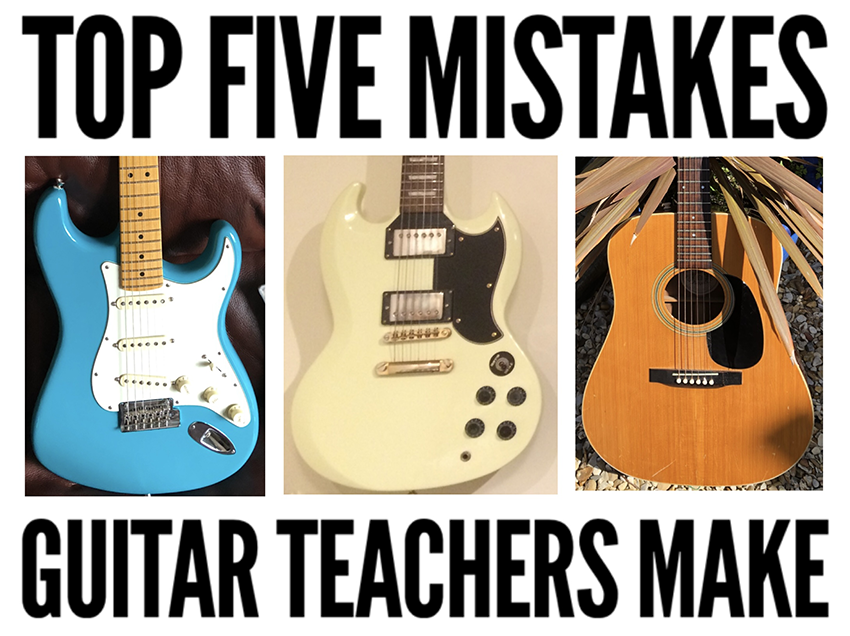
Top five mistakes made by guitar teachers
...and how to avoid making them
What I wish I had known when I started out teaching guitar. Help and advice from a lifetime guitar teacher
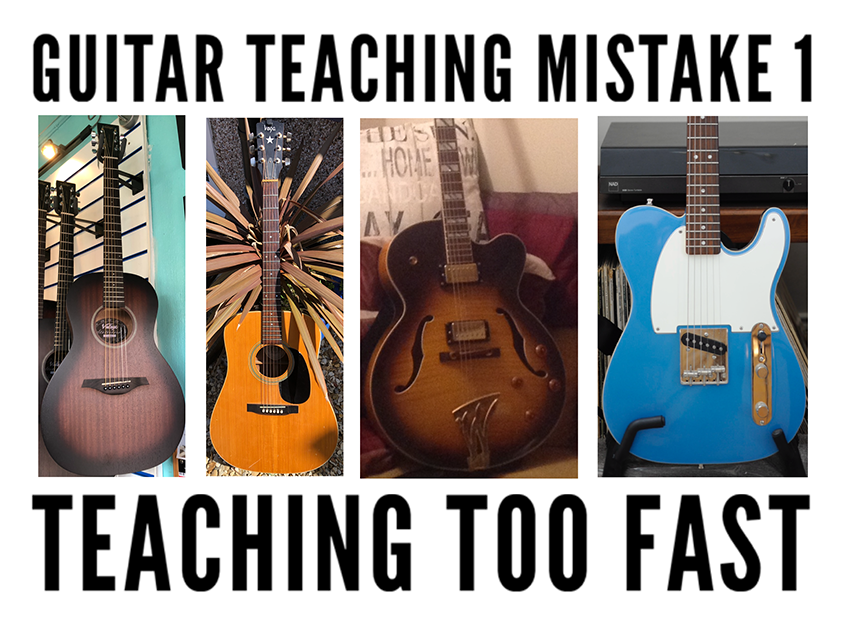
Guitar Teaching Mistake 1
Teaching too fast or too much
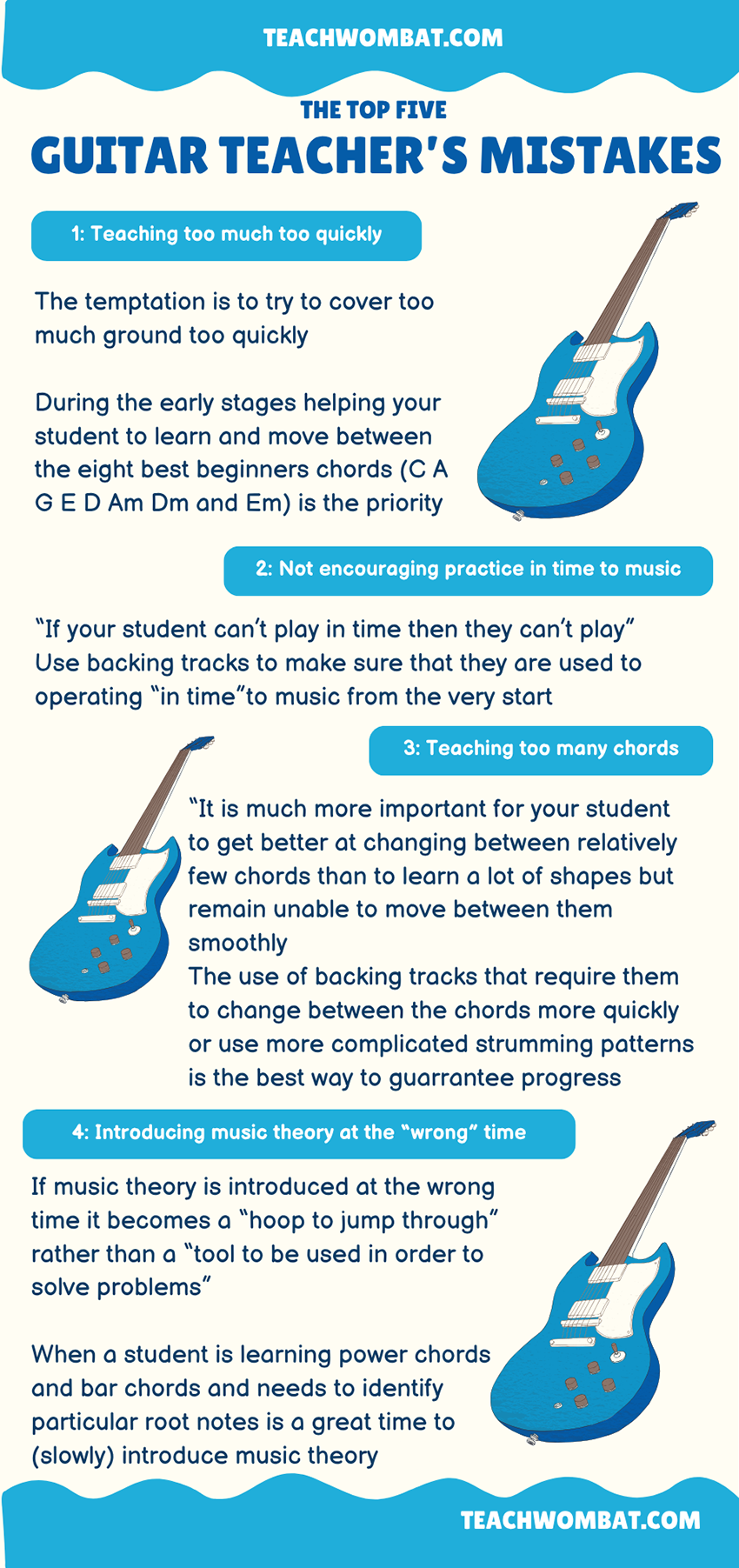
When teaching first lessons on guitar the temptation is to go too quickly and to attempt to introduce too much new material
It's an understandable mistake and one that I'm afraid I was guilty of in the early stages of my teaching career before I came to realise what the best and most sucessful guitar teachers were doing
During the early stages of a beginners progress it is important that a teacher remains aware of what the clearly defined objective is
That objective is.....
Having your student become competent at moving between the best eight beginners chords and to develop an ability to strum them in time to music
When (and only when) they can do this it is the time to start to "drip-feed" riffs, single note passages, scales and solos and new chords as appropriate
Guitar Teaching Mistake 2
Not having them play in time to music
"If they can't play in time they can't play"
When setting out to learn to play the guitar many people attempt to "cut out the middle man (or woman)" and teach themselves to play The problem is that more often that not the mistake they make is to learn chords from randomly selected songs that they like and spend a whole bunch of time learning and changing between them wondering how it does not sound like the music they love? They are putting their fingers in all of the right places and strumming the chords but the results falling out of the guitar sound hesitant, clumsy and just plain wrong
The reality is that hey are probably learning and playing the "wrong" chords for a beginner and they are not developing the ability to sound those chords on the guitar in time to music
"The intentional organisation of sound and silence in time"
Music has been defined as being "the intentional organisation of sound and silence in time" and its the "in time" part of that definition that folks who attempt to teach themselves (and bad guitar teachers too to be honest) often get all wrong
Moving between chords to backing tracks is not learning songs but it does gaurantee that a student develops the ability to act and react "in time" to music which is essential for playing "properly" If folks don't develop this capability from the beginning (thats why the backing tracks are so important) they get discouraged and give up
When a student can move between the eight beginners chords (C A G E D am Dm and Em) in time to music it is time to introduce them to the thousands (or maybe even millions- I don't know I never counted them!) songs that can be played using only those chords'
New chords should be introduced sparingly on an "as required" basis rather than as an ind in themselves as and when they are needed to play particular songs etc that a student wants to play
Guitar Teaching Mistake 3
Forgetting to re-inforce skills gained
Having taught eight chords sucessfully the temptation is (as was for a while with me) to continue the sucess by having them learn more chords This can be a huge mistake because the important thing to do at this stage is to become better at changing between the chords that they already know
By "better" I mean being able to change between then faster while using more complicated strumming patterns
Songs they know and love!
This is where songs and more advanced guitar backing tracks come in to their own and it is a good idea at this stage (when they can move between eight chords in time to backing tracks) to use those chords to develop a repertoire of songs (or fragments of songs) that they recognise and actually enjoy playing and hearing
Without going too far into the music theory as it applies to the guitar here the eight chords that every beginner should learn are used by guitar teachers the world over for two reasons
1: They are reasonably easy for a novice to learn to play
2: They are the most useful chords as mastering them allows a student to play more songs than any other similar combination of basic chords
The chords of C A G E D Am Dm and Em contain within them five of the six "important" chords in the key of G (the other one is Bm and the resources contain a beginner friendly four string version of that)
The chords of A D and E allow a student to work on Country, Blues, Pop and Rock and Roll songs in the key of A
The chords of A C D E and G lets a student work on Rock progressions in the key of A
Guitar Teaching Mistake 4
Introducing notated music and/or music theory too early
In the early stages of learning to play guitar the main (only!) thing that is important is the development of "phsychomotor skills" which is just a fancy way of saying that they need to become able to press some wires down onto a long piece of wood with one hand when hitting those wires with the other hand
They do not need to waste any of their time and drain their enthusiasm learning what a dot on a piece of paper means!
Our students do not need to be taught to play an intrument that they do not (yet) play at all in a language that they do not (yet) speak at all (musical notation)
Think about it? When you read the assembly instructions that come with flat pack furniture do you deliberately go to the part of the document that tells you how to do it in German (apologies and hats off to German folks on here who are reading this in a second language)?
* It is worth pointing out here that I do not teach classical guitar and in order to avoid a situation where I open my bedroom curtains to find my lawn full of classical guitar teachers with torches and pitchforks I will freely admit that the tradition and repertoire associated with that discipline traditionally relies on notated music from an earlier stage in the proceedings than I am advocating here
Guitar Teaching Mistake 5
Not introducing music theory until it's too late
Music theory is very important beynd the beginner/early intermediate stage of playing but it should be introduced at the right time and become regarded as a tool to solve problems rather than as end in itself
I find a great time to introduce theory is just after the eight basic beginners chords and the ability to move between them have been mastered and bar chords/power chords are being brought in to the equation
In order to play (lets say) a power chord a student needs to identify the root note of that moveable shape on (typically) the E and A strings of the guitar
This presents a fantastic opportunity to introduce the principles of note naming and of whole-step (two fret) and half-step (one fret) intervals and to use the principles under discussion to solve "real life problems" such as.... "Where on the neck can I find the power chords of E D and G that I need to play "Paranoid" by Black Sabbath?"
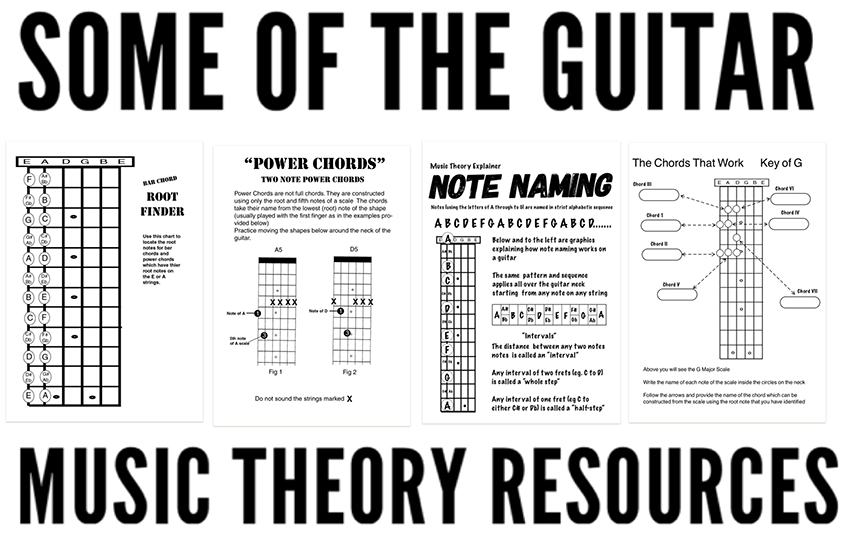
Teaching Guitar Music Theory Without Using Notated Music
Above you can see just a few of our resources designed to help guitar teachers to teach music theory
We have materials covering note naming, intervals, scales, chords and keys and all are designed to be used without relying on standard notated music

You can download over 450 PDF's and more than 35 backing tracks to make your guitar teaching easier, more organised and stress free
Follow the link below to see a full list of whats in the download
You can download and use forever all of the resources that you can see and hear on this site (thats over 450 PDF's and more than 35 backing tracks) for a frankly rediculously low price of $25.00
$25.00
HOW TO DOWNLOAD
the teachwombat materials
Buy your teachwombat.com toolkits in complete safety via any major credit card (through paypal) or directly through your paypal account if you have one. If you choose to use a credit card, rest assured that we never see your credit card details as paypal do all of that for us.
When Paypal receive your payment you will be immediately invited to click a
"RETURN TO MERCHANT"button.
You will be taken to a page from where you can download the products that you have paid for NOW!
In the (rare) event that something should go wrong with the order/download process just email me at robh@teachwombat.com
I will check the order and send you the links that will get you to your stuff.
Cheers! Rob!
They take care of the payment side and you can be sure that we never get to see your credit card details
$25.00