
















How to write songs on guitar
How to come up with chords that go together
The video above tells you how to work out the six important chords in any key
How to write guitar chord sequences that work every time
There are an infinate number of possible guitar chord sequences so how come professional songwriters use the same chords in the same order over and over again?
The answer is not because they are lazy but because the chord sequences work
The best chords for writing songs
A guitar player does not have to be much beyond the beginner stage before they can use their skill to start writing songs
Writing Blues, Rock and Roll and Country chord sequences
If your students have mastered the eight chords that any beginner should learn first and can as a consequence move comfortably between three of those chords (G, C and D) they can use them to play and write Rock'n'Roll, Pop, Blues and Country Songs
Writing Doo Wop and Soul chord sequences
Throw in another of the chords (Em) and they have the harmonic capability to play and write Soul and Doo-Wop tunes
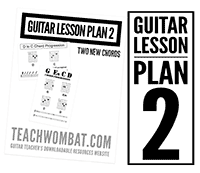
By combining these four chords a musician or songwriter is (whether they know it or not) using the World Famous "Four Chord Trick" that works in all keys (as shown on the worksheet in the image below) and if you are not familiar with it you may like to follow the link to find out more about the four chords that combine to create the harmonic basis of tens of thousands (at least!) of sucessful songs
Beyond The "Four Chord Trick"
Two more easy chords from the eight (Am and Em) will allow your guitar students to expand those playing and compositional capabilities to include thousands (and probably millions (I never got around to counting them) of other songs
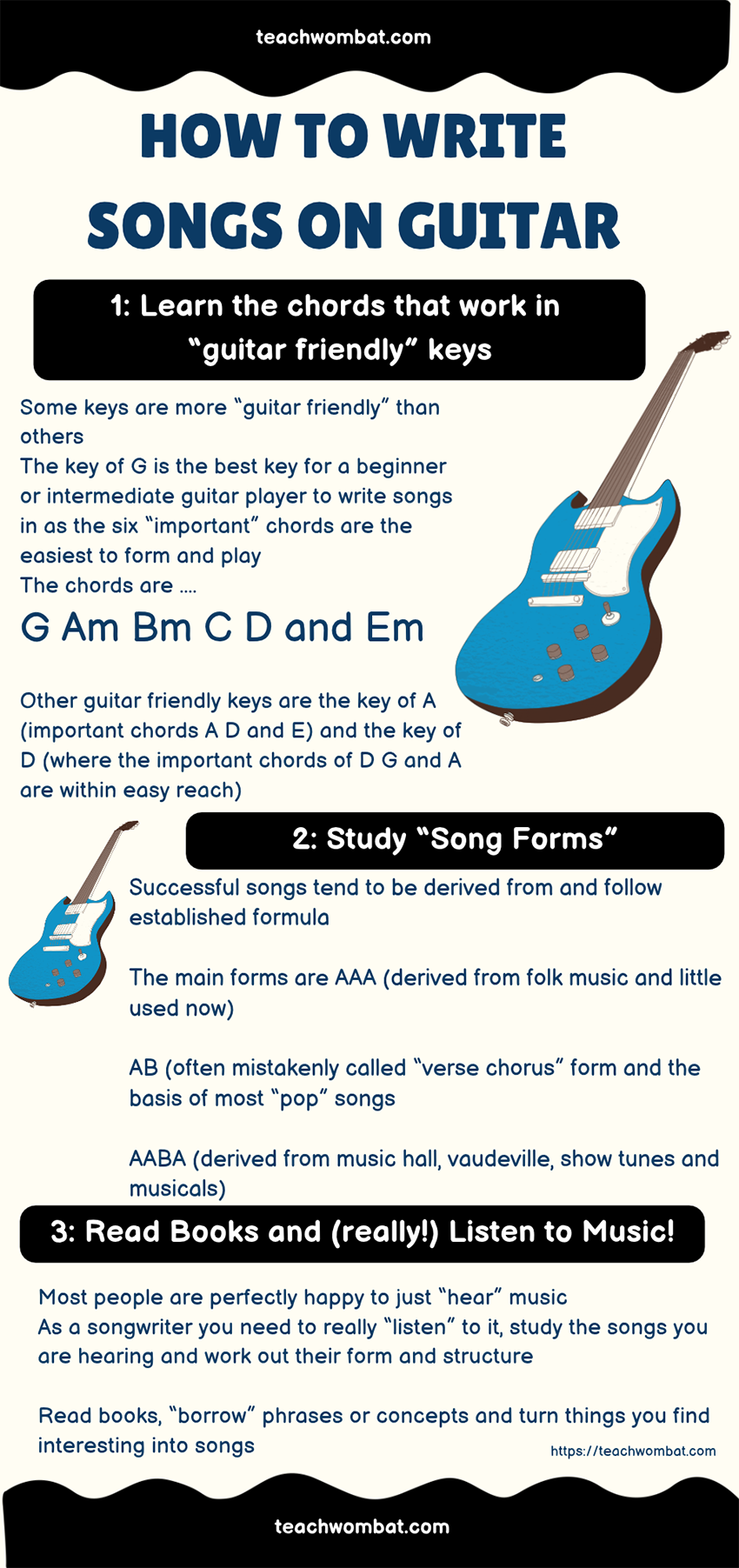
Throw in a Bm (which is normally played as a bar chord but there is a four string "easy" version that beginners can use) and you have the six "useful" chords in the key of G (every key has six "useful" chords contained within it)
"You do not have to be a good guitar player to write great songs!"
What Is a song?
A song is the audible result of combining lyrics, chords and a melody
As guitar teachers we can be forgiven for concentrating our attention to the musical (rather than lyrical) elements outlined above
The Problem With Writing Songs On Guitar
The problem with writing songs on guitar normally has nothing to do with the guitar and everything to do with the player who is writing the song
It is quite possible (and by no means unusual) for someone to write a perfectly acceptable (or even a wonderful) song on a guitar without having the first clue what they just did and even as a guitar teacher I think that that is totally and utterly fantastic
There must not and never should be any "barriers to entry" with regard to the right to operate and function as a songwriter
If someone "accidentally" writes a good or even great song then it is something to be celebrated but if they want to repeat the process and develop as songwriters it is a good idea that they understand what it is that they are doing
The best guitar teachers all oiver the world start by teaching their students to move between eight chords (which include seven of those mentioned above) to allow their students to function in the key of G Major
Writing Songs In All Genres on Guitar
In the video at the top of this page I look at the incredibly important "diatonic" system of harmony (where you can build a specific chord on each degree of any major scale and then move freely between them). This material on this page covers almost all Rock, Pop, Country, Funk, Punk, Blues, Souls and Disco tunes and if developed further is the basis for an introduction to Jazz guitar too. It provides guitar students with a framework for understanding how the same chord progressions turn up time and time again in popular music (just in loads of different keys so you don't really realise that they are the same) and this material can provide a great "jumping off point" for guitar players looking to create their own songs and progressions

A song is composed of a number of elements including the lyrical and melodic content but we are concerning ourselves as guitar teachers with perhaps the most basic question. How to come up with chord sequences that will "work"? The wonderful thing about introducing this concept at this stage is that it gives our students a practical reason to study music theory because the knowledge derived from that study will give them a "foolproof" sytem for writing chord sequences that will sound "right" without them floundering around the neck until they accidentally come up with something that conforms to the "rules" that they are as yet unaware of
"Meet the New Boss" (the brain takes over)
When they are able to move between the eight beginners chords can comfortably play the F chord is a good time to mention to your student that up until this point their progress has been based upon developing skills and capabilities in their hands and fingers An almost purely physical skill based around becoming capable of pressing some wires down onto a long piece of wood with the fingers of one hand in time with rhythmical movement (strumming patterns) carried out by the other hand (arm) Thats all they have really been doing for the last few months The brain has been largely absent from proceedings and now it is time for the brain to step in and tell the hands what to do
The objectives of this period of study are to enable our students to properly identify the notes of any major scale and from there to assign the "correct" chord type (major, minor or diminished) to that root note This will allow them to work out (and eventually know) the diatonic chords that can be found in any key "Diatonic" chords are those chords which can be constructed from (only) the notes of any parent Major Scale
Take your time with this material
It is important to realise (and to stress to your student) that this material is not designed to be covered in a single session before you move onto something else but rather that it is the beginning of a process by which you transfer the control of the guitar from the hands (where it has been up to this point) to the brain Once a little way into this period of study it will be perfectly possible for your student to compose chord sequences that function at the first time of asking without there even being a guitar in the room as well as to understand the chord sequences and songs that they can already play they will develop the ability to look at a set of chords and identify the "key" that the progression is in and from there make decisions about chords that may be used alongside the chords identified and scales that can be used to construct melodies or solo lines Up until this point learning to play the guitar has (hopefully?) been absorbing and satisfying This new phase can be looked upon as the point at which learning to play the guitar gets "interesting" as it is not just about playing the guitar but about "understanding" it
Writing "Rock" Guitar chord Progressions
Five of the eight beginners guitar chords (A C D E and G) can be used to write Rock chord progressions that work every time
Take a look at the video below to see the theory in action
How to write Rock songs on guitar
How the theory of writing Rock chord progressions works
The video that I have up there on youtube that looks at a great and simple way to get guitar students into writing their own original music. In a nutshell if you want to write an effective "Rock" (as opposed to pop) chord progression all you need to do is hang Major chords onto each degree of a pentatonic minor scale and move between them. The video looks at the best keys to do it in and provides a simple theoretical framework for the whole thing
A lifetimes supply of Guitar teaching Resources to help you to earn a living that will probably cost less than you will earn when you teach your first hour long guitar lesson!
The Deluxe Package:
Download all of our guitar teaching products (everything that you see on this site) for just $25.00

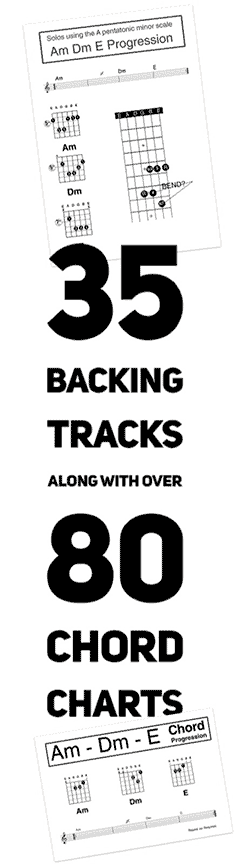
The Download Contains....