













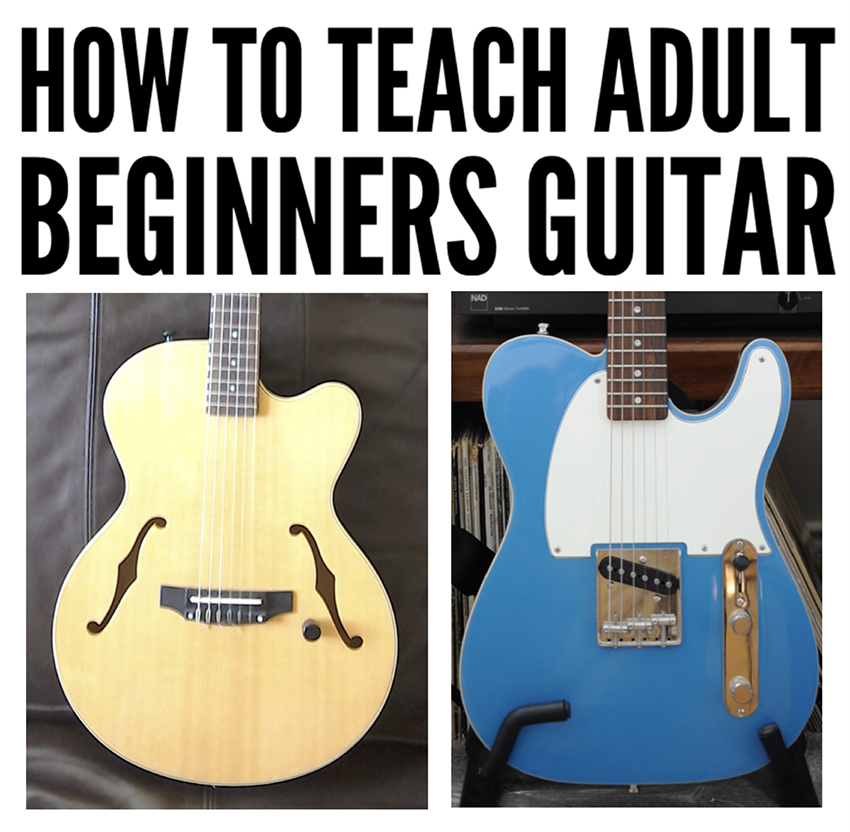
How to teach adult beginners guitar
The difference between teaching adults and teaching children to play guitar can be illustrated by how well your lessons stand up with relation to the following two questions
Children ask themselves “Is this fun NOW?” and if it is then they will happily go along with whatever you are doing in the guitar lesson
Adult guitar students are different
Adults choose to give you hard earned money and they come to you for a first guitar lesson because in return they (not unreasonably) expect that you will supply them with the best and quickest way to become a functioning guitar player
When faced with a situation where they are asked to do something like practice a particular chord progression or fingering exercise on guitar adults ask themselves one simple question...... “What’s in it for me?”
If they do not feel that the activity will help them move towards becoming the type of guitar player that they (currently) want to be then they will (sometimes very quickly) make the decision to go to another teacher or to stop playing guitar altogether
Guitar teachers and their adult students should agree objectives from the start
When you teach adult guitar students you need to very quickly agree with them a set of desirable and achievable short and medium term objectives that you will work towards in order to have them make progress towards the goal of becoming a competent guitar player within a relatively short period of time
It is a good idea to explain that what you are jointly trying to do is get them from where they are now to a point where they are functioning properly at a basic level on the instrument
They need to become able to……..
1: Move between a set of open chords that are chosen to be most useful to them
This is the focus of the first five beginners guitar lessons
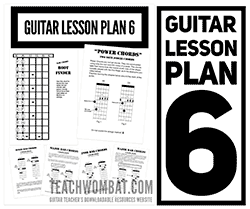
2: Work on power chords and bar chords and the ability to select where to play them on the neck of the guitar
From lesson six onwards it is possible to introduce very basic music theory by helping your students to identify the root notes of power chords based on the two bottom strings of the guitar
3: Start to develop a repertoire of songs (or fragments of songs such as hooks or choruses etc) that they can play in order to develop familiarity with the physical act of playing the guitar
Repertoire is very important to adult students
Most importantly in the early stages they need to work towards the development of repertoire in terms of helping them to become able to play music that they already know and love and to develop an understanding of how the nuts and bolts (not necessarily the inspiration) of chord progressions and songwriting works
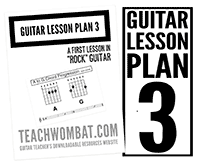
Adults have a long history of hearing music and experienced guitar teacher know to us this to their advantage From the very first guitar lesson (where the chords of G and Em are introduced) a teacher can point out examples from popular music of those two chords being used together
The idea is not to spend a huge amount of time on the fragments of songs that can be played using just G and Em but to let a student see “what’s in it for them?” If they go along with your suggestion to learn to move between the two chords
I tend to bring up the example of “The Locomotion” (G) “Everybody’s doing a (Em) brand new dance now (G) C’mon baby (Em)do the locomotion “
Another one I use (depending on the age and tastes of my student) is the opening to “Hallelujah”
Some older adult students may know the Leonard Cohen original version but a whole load more folks know the Tim Buckley version that was featured in the “Shrek” movie
It’s a great one for demonstrating how useful it can be to learn the chords of G and Em as even after a first lesson a real musical sounding result can be achieved by using just a single strum as each chord changes
“I’ve (G) heard there was a (Em) secret chord that (G) David played and it (Em) pleased the lord”
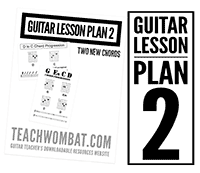
I also love using this example as the next two chords in the song are C and D which are the chords covered in the second beginners guitar lesson
“But (C) you don’t really (D) care for music (G) do you (D)
The above is a snapshot of my professional practice but the truth is that the songs referenced are provided merely as illustrations to demonstrate the idea of letting a student know that even with as few as two chords under their belts they will be capable of making music that they recognise
That’s what’s in it for them!
